The Hello That Went Completely Off the Rails Before Either of You Could Stop It
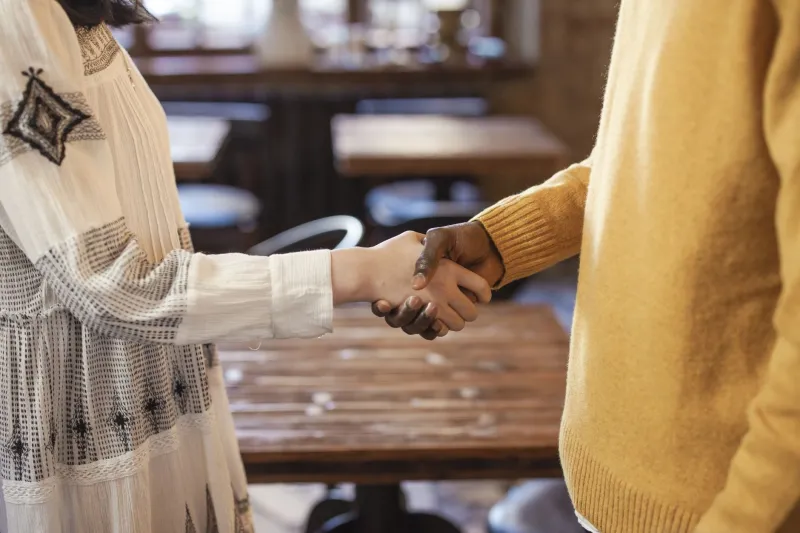
It should have been simple. You saw someone you know — not a close friend, not a total stranger, but one of those mid-tier acquaintances where the correct greeting protocol is genuinely ambiguous — and you both moved toward each other with the mutual intention of saying hello. That was the last thing you agreed on.
What happened next was a live, unrehearsed, completely unrecoverable physical negotiation that ended with both of you doing something that wasn't a handshake, wasn't a hug, and wasn't anything that has an established name. You laughed. They laughed. You both said "ha, sorry" at exactly the same time. And then you stood there for a half-second too long, wondering if you should try again or just accept that the greeting had failed and move directly into conversation as if the opening act hadn't just collapsed on stage.
Oh, that happens.
The Pre-Greeting Commitment Window
The problem begins approximately two seconds before contact, in what can only be described as the commitment window. This is the moment where both parties read each other's body language and decide on a greeting format. The window is extremely short. The information available is minimal. And crucially, there is no communication channel — you cannot say "I am going in for a handshake" without making the entire interaction exponentially more awkward than whatever collision is about to occur.
So you read the signals. They are walking toward you with arms in an ambiguous position — not fully extended for a handshake, not open for a hug, not raised for a wave, not curled for a fist bump. They are in a kind of greeting no-man's-land, and you are making your decision in real time with approximately the same information a coin flip would give you.
You commit. You are wrong.
The Five Stages of a Greeting Misfire
Stage one is the approach, where everything still seems fine and the greeting feels imminent and manageable.
Stage two is the divergence — the moment you realize, with a clarity that arrives too late to be useful, that you have selected different greeting formats. Your hand is extending. Their arms are opening. The gap is closing. There is no abort sequence.
Stage three is the collision, which takes many forms. Sometimes it's a handshake that becomes a weird forearm clasp because one person pivoted toward a hug mid-motion. Sometimes it's a hug that becomes a side-pat because the other person didn't fully commit. Sometimes it's a fist bump that connects with someone's open palm, which feels like a greeting from a parallel dimension where different social norms evolved.
Stage four is the laugh. The laugh is mandatory. The laugh is the social equivalent of saying "we both saw that and we are choosing to process it as humor rather than as the minor catastrophe it actually was." The laugh does not fix anything. The laugh is just the sound of two people agreeing to never discuss this again.
Stage five is the overcorrection — the moment where one or both parties, in an effort to demonstrate that everything is normal, becomes aggressively, unnaturally relaxed. They lean back. They smile too wide. They say "anyway!" with an enthusiasm that belongs at a pep rally, not a Tuesday afternoon grocery store parking lot.
The Specific Chaos of the Pandemic Aftermath
If greeting choreography was complicated before 2020, it became a full psychological obstacle course after. The pandemic quietly eliminated whatever fragile consensus existed around physical greetings and replaced it with a five-year experiment in improvised alternatives — the elbow bump, the wave, the nod, the verbal acknowledgment from six feet away — and now everyone is attempting to recalibrate back to something resembling normal contact without a shared memo about what that actually means.
Some people are fully back to hugging everyone. Some people are still waving from a distance and feeling fine about it. Some people have landed on a handshake-adjacent position that they deploy inconsistently depending on factors they cannot fully articulate. The result is that every greeting now carries a small but nonzero chance of becoming an unintentional interpretive dance.
The People Who Make It Worse
Special recognition must go to the person who, after the misfire, attempts a full reset. This is the individual who says "wait, let's try that again" and physically backs up to restart the greeting from scratch, as if the problem was execution rather than the fundamental impossibility of two people spontaneously agreeing on physical contact in under two seconds.
The reset never works. The reset just gives everyone a second opportunity to diverge. Now there have been two greeting failures in under fifteen seconds, and the social debt is compounding at a rate that no amount of "ha, I don't know why that's so hard" can adequately service.
The Quiet Decision to Never See This Person Again
Somewhere in the aftermath of a truly spectacular greeting failure, a small but definitive internal calculation occurs. It is not dramatic. It is not even fully conscious. It is simply the quiet registration that seeing this person again means eventually having to greet them again, and the probability of a second misfire — now loaded with the memory of the first — is frankly not something you are emotionally prepared to manage.
This is how acquaintanceships end. Not with a fight, not with a falling out, but with a handshake that became a hug that became a forearm clasp that became a mutual agreement, never spoken aloud, to simply let this one fade.
You wave from across the parking lot next time. They wave back. The distance is a little too far for a hug anyway.
Problem solved.